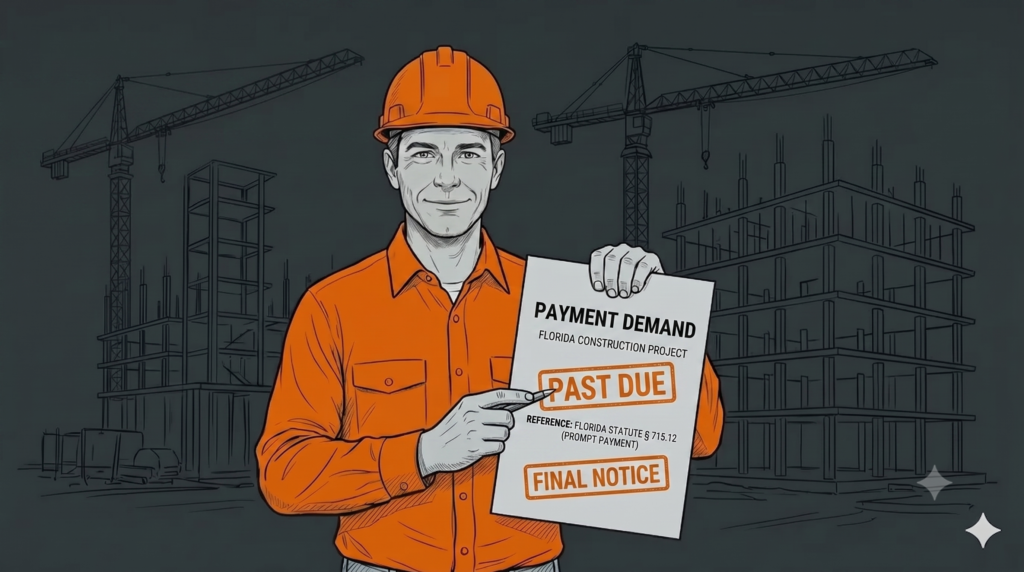
The invoice is in. The work is done. The money is not coming.
Maybe the owner says there is a dispute. Maybe the GC says it has not been paid yet. Maybe no one is saying anything at all and the calls are going to voicemail. Whatever the excuse, Florida law does not care about the excuse. Florida has three prompt payment frameworks: the Construction Contract Prompt Payment Law for private work, the Florida Prompt Payment Act for state public work, and the Local Government Prompt Payment Act for county, city, school board, and special district work. All three impose mandatory deadlines, automatic interest, and real consequences for the party that is not paying.
Most Florida contractors and subcontractors know they have lien rights. Far fewer know they also have a parallel set of payment rights that can generate statutory interest at up to 24 percent per year and, on public jobs, the ability to freeze a GC’s project funds in court within 15 days of filing. No proof of irreparable harm required.
Nonpayment is also a breach of contract, and your remedies run on parallel tracks: the statutory interest claim, the lien or bond claim, and the underlying breach of contract action. This article focuses on the first track — what the prompt payment statutes actually require, what the courts have said about the clauses owners and GCs use to avoid paying, and exactly what steps to take when a contractor or owner refuses to pay.
Which Law Applies to Your Job
The answer depends on who owns the project.
Private projects, owned by a developer, homeowner, or commercial property owner, are governed by the Construction Contract Prompt Payment Law, Florida Statute § 715.12. If your project is Chapter 713 lien-eligible, § 715.12 applies.
State agency projects, meaning state departments, universities, and state entities, are governed by the Florida Prompt Payment Act, §§ 255.0705–255.078, with §§ 255.073–255.074 covering construction payments specifically.
Local government projects, meaning counties, municipalities, school boards, and special districts, fall under the Local Government Prompt Payment Act, §§ 218.70–218.79, with § 218.735 as the key construction provision.
If you are a subcontractor, the same frameworks apply to you. The public entity pays the GC under the public project statute. The GC pays you under those same downstream requirements. The deadlines run through the entire chain.
The Deadlines and What Starts the Clock: How Long Does a Contractor Have to Pay?
Private Projects
On a private job, the payment obligation under § 715.12(4) is triggered when three things are true: the obligee is entitled to payment under the contract and has submitted a written payment request; unless the obligor is the owner, the obligor has been paid for that work by the party above it in the chain; and the obligee has furnished all affidavits or waivers the owner needs to make proper payments under § 713.06.
Where the owner and contractor agreed to retain part of the progress payments, the owner’s final payment to the contractor, including the retained amounts, is due within 14 days after any one of the following (the owner’s written punchlist must be delivered within the time the contract sets or, if the contract is silent, within 15 days after the triggering event):
- An architect or engineer certifies substantial completion and the contractor substantially completes the owner’s written punchlist;
- A certificate of occupancy is issued and the punchlist is substantially completed; or
- The owner or its tenant takes possession and the punchlist is substantially completed.
Note that between the owner and the contractor, retainage on a private job does not get its own separate timeline. It rides on the same 14-day final payment deadline.
If a payment request is incomplete or has errors, the obligor has 14 days to return it with written reasons. A timely written return resets the interest calculation to the 14th day after the corrected request is submitted and payment is otherwise due. If the obligor does not return the request with written reasons within 14 days, statutory interest is owed as if the request had been proper. § 715.12(5)(b).
Public Projects: State Level
Under § 255.073, if any portion of a payment request is disputed, the undisputed portion must still be paid by the earlier of the contractually required date or 20 business days after receipt of the request. Once the GC receives payment from the public entity, it must remit to subcontractors within 10 days. Subcontractors must then pay their sub-subcontractors and suppliers within 7 days.
The 2023 legislative session (Laws 2023, c. 2023-134, effective July 1, 2023) updated §§ 255.073–255.074, refining the procedures for payment processing and the stamped-as-received requirements that anchor the deadline calculations. The current rules have been in effect since July 1, 2023.
Local Government Projects
Under § 218.735, the payment deadline for local government entities is 25 business days after the invoice is stamped as received when an agent must approve the invoice, or 20 business days if no agent approval step is required. The same 10-day downstream rule applies: GCs must pay subcontractors within 10 days of receiving payment, and subcontractors must pay their subs and suppliers within 7 days.
|
Deadlines by tier at a glance Private projects: Owner → GC within 14 days of triggering event State public: Agency → GC within 20 business days (undisputed amounts) Local government: Entity → GC within 25 business days (with agent) / 20 (without) All public projects: GC → Sub within 10 days of receipt | Sub → Sub-sub within 7 days |
The Interest You Are Owed
Late payment is not free. Florida’s prompt payment statutes impose mandatory interest that accrues automatically. No additional notice required. No court order needed. On public projects, no contract clause can eliminate it.
Private Projects
Section 715.12 mandates interest at the rate established by § 55.03, Florida’s judgment interest statute. It resets annually based on the Federal Reserve discount rate plus 500 basis points. The statute adds plus an additional 12 percent per annum. That combined rate typically runs between 17 and 21 percent annually depending on the current § 55.03 figure. Interest begins running on the 14th day after payment is due.
One protection most contractors do not know about: you cannot waive the right to statutory interest before the payment comes due. § 715.12(6)(d). A contract clause that tries to sign that right away in advance does not work. Once a payment is actually due, interest can be waived, for example in a settlement, so read what you sign at that stage.
Public Projects
Section 255.073(4) imposes interest at 2 percent per month, which works out to 24 percent per year, on all payments not made within the applicable deadline on state public projects. Section 218.735(9) imposes the same 2 percent per month rate, or the contractual rate, whichever is greater, on local government projects.
Section 255.075 goes further: it explicitly prohibits any public entity contract from containing a term that would bar the collection of late payment interest under § 255.073(4). Any such clause in a public contract is void on its face.
To put it in real numbers: if a GC holds back $50,000 for 90 days on a public project, the interest alone is $3,000. At six months, it is $6,000. The statute is designed to make late payment expensive enough that paying on time is the easier path.
The Rule Most Contractors Do Not Know: Undisputed Amounts Must Be Paid
This is the most practically powerful protection in Florida’s prompt payment framework and the one that gets ignored most often by owners and GCs.
Under § 715.12(6)(e) on private projects, unless the contract specifically provides otherwise, a dispute between the parties does not permit the obligor to withhold payment for work that is not affected by the dispute. If the owner has a legitimate complaint about five percent of your scope, it does not get to hold the other 95 percent. The undisputed amount is due on the statutory deadline. Period.
Under § 255.073(3) on public projects, a contractor or subcontractor may dispute a portion of a payment request in writing, specifying the disputed amount and the cure required. But all undisputed amounts must still be paid on time. A blanket dispute with no specifics and no dollar figures does not satisfy the statute and does not pause the payment clock on the amounts that are clearly owed.
When someone tells you they are withholding everything because of a dispute over something, ask them in writing to identify the specific disputed amount and the specific deficiency. If they cannot, the entire amount is arguably due.
|
The undisputed amounts rule in plain English A partial dispute does not give the other side the right to hold everything. If they have a legitimate complaint about part of the work, they must still pay for the rest. Ask for the specific disputed amount in writing. No specifics = no valid basis to withhold. |
Pay-When-Paid: The Clause That Sounds Like a Defense But Usually Is Not
The GC’s subcontract says something like: “Payment to subcontractor is contingent upon receipt of payment from the owner.” The owner has not paid. The GC says it does not owe you anything. Is that right?
Contractors and GCs use the terms “pay when paid” and “pay if paid” interchangeably, but the distinction matters. A true pay-if-paid clause makes the owner’s payment a condition precedent — if the owner never pays, the GC never owes the sub. A pay-when-paid clause, by contrast, only addresses timing: the GC still owes the money and must pay within a reasonable time even if the owner never comes through. In Florida, the courts presume every such clause is the second kind unless the contract says otherwise in unmistakable terms.
So the answer to the question above is almost certainly no — unless the language is precisely, unambiguously drafted to shift the risk of owner nonpayment onto the subcontractor. The controlling case is Peacock Construction Co. v. Modern Air Conditioning, Inc., 353 So.2d 840 (Fla. 1977), a Florida Supreme Court decision that has governed this issue for nearly 50 years.
The Court’s holding is simple: absent clear and unambiguous language making the owner’s payment a condition precedent to the GC’s obligation to pay, pay-when-paid clauses are interpreted as fixing only a reasonable time for payment. They are not a permanent defense to paying. The Court put the burden squarely where it belongs: “The burden of clear expression is on the general contractor.”
What Language Courts Have Upheld
Florida courts have enforced pay-when-paid clauses as true conditions precedent, but only when the language is specific and direct.
A clause requiring final payment “within thirty days of completion… and as a condition precedent, receipt of final payment… from the Owner or Prime Contractor” was enforced — the court found it hard to imagine a clearer expression of intent to shift the risk of nonpayment onto the subcontractor. Dyser Plumbing Co. v. Ross Plumbing & Heating, Inc., 515 So.2d 250 (Fla. 2d DCA 1987).
Two subcontract clauses, one making final payment contingent on the owner paying the contractor and one conditioning payment for disputed change-order work on the owner’s payment, were likewise enforced as unambiguous conditions precedent. Because the owner had not paid, the subcontractor’s suit was premature. Robert F. Wilson, Inc. v. Post-Tensioned Structures, Inc., 522 So.2d 79 (Fla. 3d DCA 1988).
What Language Courts Have Rejected
- “Until” the contractor is paid by the owner was found ambiguous and not a condition precedent. Snead Construction Corp. v. Langerman, 369 So.2d 591 (Fla. 1st DCA 1978).
- Payment “within ten working days after contractor was paid by owner” only fixed a reasonable time for payment. It was not a condition precedent. The same subcontract’s separate, specific retainage clause, which let the contractor hold five percent until it received final payment from the owner, was enforced. Bentley Construction Development & Engineering Inc. v. All Phase Electric & Maintenance, Inc., 562 So.2d 800 (Fla. 2d DCA 1990).
- Even an otherwise clear pay-if-paid clause failed when the prime contract, incorporated into the subcontract, required the GC to show its subs had been paid before the owner’s final payment came due. Read together, the documents conflicted, the conflict created an ambiguity, and the ambiguity was resolved against the GC, so the sub was owed payment within a reasonable time. International Engineering Services, Inc. v. Scherer Construction & Engineering of Central Florida, LLC, 74 So.3d 531 (Fla. 5th DCA 2011).
Payment Bonds: Public and Private Jobs Differ
On a public project, a clear pay-if-paid clause may delay or bar payment from the contractor, but it does not excuse the surety’s statutory payment bond obligation under § 255.05. Everett Painting Co. v. Padula & Wadsworth Construction, Inc., 856 So.2d 1059 (Fla. 4th DCA 2003). Private projects are different: under § 713.245, a properly documented conditional payment bond may make the surety’s obligation match the contractor’s expressly conditional duty to pay. If a payment bond exists on your job, read the bond itself before assuming the subcontract controls.
If It Is a Public Project: The Tool Nobody Uses
Most Florida contractors working on public jobs have never heard of § 255.071. It is one of the most powerful payment enforcement tools in Florida construction law and one of the most underused.
Here is what it does: if you furnished labor, services, or materials on a public project, the party above you has been paid for your work, and the undisputed amount has gone unpaid for more than 30 days after furnishing and after it became due (or past the § 255.073(3) deadline, whichever is later), you can file a verified complaint in circuit court. The court must then schedule an evidentiary hearing on not less than 15 days’ written notice. At that hearing, you can obtain:
An accounting of the use of the payment from the person who received it;
A temporary injunction against the person who received the payment, subject to standard bond requirements; and any other legal or equitable relief the court finds appropriate.
The statute makes these remedies available “without regard to any other remedy at law and without regard to whether or not irreparable damage has occurred or will occur.”
That last part is the key. Normally, getting a temporary injunction in Florida requires proving that you will suffer irreparable harm if the court does not act. Section 255.071 removes that requirement entirely. You still have to plead and prove the statutory elements, including that the party above you was paid, but you do not have to prove irreparable harm.
And under § 255.071(7), the prevailing party is entitled to recover costs and a reasonable attorney’s fee at trial and on appeal.
The practical effect: the threat of a § 255.071 filing, a hearing on as little as 15 days’ notice, a potential freeze on project funds, and mandatory fee exposure resolves most public project payment disputes before the hearing date arrives. File it. Use it.
|
Section 255.071 in plain English Undisputed payment on a public project, unpaid more than 30 days past due, and the party above you was paid. File a verified complaint. Court holds a hearing on at least 15 days’ notice. No irreparable harm required. Funds can be frozen. Prevailing party recovers attorney’s fees. The threat alone often resolves it before the hearing date. |
What to Do Right Now When a Contractor or Owner Won’t Pay
If you are not getting paid on a Florida construction project, here is the sequence that protects your position.
- Confirm your documentation is complete before you do anything else. Written contract, submitted pay applications or invoices, dated proof of delivery, and any rejections from the other side in writing. If rejection notices were given without specifying the deficiency, they may not have tolled the interest clock.
- Send a written demand letter. A Florida demand letter for construction nonpayment should identify the specific amount owed, the date it was due, the applicable statute, and the interest accruing daily. On a public project, state that you reserve the right to file a verified complaint under § 255.071. Put the other side on notice that you know the law.
- On a private project, preserve your lien rights in parallel. Do not wait to see if the demand letter works. If you are inside the 45-day NTO (Notice to Owner) window or the 90-day lien filing deadline, preserve those rights now. A properly perfected lien is your most powerful collection tool on a private job and your path to mandatory attorney’s fees under § 713.29. Section 715.12 alone does not provide that path.
- Ask them to identify the disputed amount specifically and in writing. If they are withholding on a dispute, the undisputed amounts are still due. A blanket dispute is not enough. Get their specific objection in writing. If they cannot produce one, that matters.
- On a public project, consider filing the § 255.071 verified complaint. If the undisputed amount is more than 30 days past due and the party above you has been paid, the mechanism is available. A hearing on as little as 15 days’ notice moves fast. The threat of frozen project funds and mandatory fee exposure often moves the money faster than any demand letter.
- Serve your Notice of Nonpayment within 90 days. On public projects requiring a payment bond under § 255.05, a written Notice of Nonpayment must be served on the contractor and the surety within 90 days of last furnishing. Miss that deadline and you lose the payment bond claim regardless of what else you do right. If you are not in privity with the contractor, you also must have served a timely notice to contractor under § 255.05(2) after you began furnishing.
- Be careful at final closeout. The Fourth District held in Construction Consulting, Inc. v. District Board of Trustees of Broward College, 347 So.3d 14 (Fla. 4th DCA 2022), that depositing final payment checks sent with a reconciliation report calling them the final payment was an accord and satisfaction, and that the contract’s clause making acceptance of final payment a release independently barred the contractor’s remaining claims, including its claim for statutory interest. Before you deposit any final payment check that comes with documentation, read what that documentation says.
Frequently Asked Questions
Can I sue a contractor or owner for non-payment in Florida?
Yes. There is no mandatory waiting period before you can file suit for nonpayment on a Florida construction project. What matters is that the payment was due and was not made. On final payment, the obligation arises 14 days after the triggering event under § 715.12. Interest begins accruing on the 14th day. You can file suit once the payment is late. The more urgent question for most contractors is whether lien rights are about to expire. The 45-day NTO window and 90-day recording deadline cannot be recovered once they are gone.
How long does a contractor have to pay a subcontractor in Florida?
On public projects, a GC must pay its subcontractors within 10 days of receiving payment from the public entity, and subcontractors must pay their sub-subcontractors and suppliers within 7 days. On private projects, the timing runs through § 715.12: once the GC has been paid and the sub has submitted a proper payment request with any required lien waivers, payment obligations are triggered, with final payment due within 14 days of the statutory triggering events. Interest accrues automatically once these deadlines pass.
What can a subcontractor do if the contractor refuses to pay?
A subcontractor who has not been paid has several tools that work at the same time. First, demand in writing that the GC identify any specific disputed amount — undisputed amounts generally must be paid on the statutory deadline even when part of the invoice is disputed. Second, statutory interest is accruing automatically: up to 24 percent per year on public projects. Third, on a private project, preserve lien rights before the 45-day Notice to Owner and 90-day lien deadlines pass. Fourth, on a bonded public project, serve a Notice of Nonpayment on the contractor and surety within 90 days of last furnishing. And on a public project where undisputed payment is more than 30 days late, a § 255.071 verified complaint can put the GC in front of a judge on as little as 15 days’ notice.
Can an owner withhold everything because of a dispute over part of the work?
No. Unless the contract specifically provides otherwise, Florida Statute § 715.12(6)(e) prohibits withholding payment for work not affected by a dispute. If the dispute concerns a specific portion of the work, only that portion can be withheld. The rest is due on the statutory deadline. On public projects, § 255.073(3) requires the same: undisputed amounts must be paid on time regardless of any partial dispute. Ask for the specific disputed amount in writing. If they cannot identify it, the entire invoice is arguably due.
What is the difference between pay-when-paid and pay-if-paid?
A pay-if-paid clause makes the owner’s payment a true condition precedent — if the owner never pays the GC, the GC never owes the subcontractor. A pay-when-paid clause only sets the timing of payment; the GC’s debt survives even if the owner defaults. Under the Florida Supreme Court’s decision in Peacock Construction Co. v. Modern Air Conditioning, Inc., 353 So.2d 840 (Fla. 1977), every such clause is presumed to set only a reasonable time for payment, not to eliminate the GC’s obligation to pay entirely. To shift the risk of owner nonpayment onto the subcontractor, the contract must use clear, unambiguous language like “as a condition precedent, receipt of payment from the owner.” Words like “when” or “until” are typically not enough. On public projects, even an enforceable clause does not excuse the surety’s payment bond obligation under § 255.05. Private conditional payment bonds under § 713.245 can be different.
What interest rate applies under the Florida Prompt Payment Act?
It depends on the project. On private projects under § 715.12, the rate is the § 55.03 judgment interest rate plus 12 percent per year, beginning on the 14th day after payment is due. That combined rate typically runs 17 to 21 percent annually. On state public projects under § 255.073(4) and local government projects under § 218.735(9), the rate is 2 percent per month, which is 24 percent per year. Interest on public projects accrues automatically once the statutory deadline passes. No additional notice or demand is required.
Can I get attorney’s fees if I have to sue to get paid?
On a private project, § 715.12 alone does not provide attorney’s fees. The path to fees on a private job is through Chapter 713: if you enforce a valid construction lien, § 713.29 mandates that the prevailing party recovers a reasonable attorney’s fee for trial, appeal, or arbitration. The Florida Supreme Court clarified in Trytek v. Gale Industries, Inc., 3 So.3d 1194 (Fla. 2009) that courts must use the significant issues test to decide who prevailed, and that a court may find that neither side prevailed. On public projects, § 255.071(7) mandates attorney’s fees for the prevailing party in a verified complaint proceeding, at trial and on appeal.
What happens if the lien was transferred to a bond? Do the same rules apply?
Yes, with one critical difference. If the property owner transferred your lien to a bond or cash deposit under § 713.24, your claim now runs against that security rather than the real property. To preserve the lien remedy, you must timely bring your claim against the transferred bond or deposit. A suit against the owner alone does not preserve it. If the owner records a notice of contest, your time to sue can shrink to 60 days under § 713.22(2). On public payment bond claims under § 255.05, serve the written Notice of Nonpayment on both the contractor and the surety within 90 days of last furnishing. That notice is a condition precedent to recovery.
Key Takeaways
|
Key Takeaways
Florida has three prompt payment frameworks. Private jobs: § 715.12. State public jobs: § 255.073. Local government jobs: § 218.735. The deadlines and interest rates are different. Know which one applies before you send a demand.
Interest is automatic. On public projects it is 2 percent per month, 24 percent per year. It runs from the moment the deadline passes. No additional notice required. No court order needed.
A partial dispute does not justify withholding everything. The undisputed amount is still due on the statutory deadline, unless a private contract specifically provides otherwise. Ask for the specific disputed amount in writing. No specifics, no valid basis to hold.
Pay-when-paid clauses are presumptively unenforceable as conditions precedent in Florida. Only a true pay-if-paid clause, in unmistakable terms, shifts the risk of owner nonpayment. The burden of clear expression is on the GC. Words like ‘when’ and ‘until’ are not enough.
On a private project, preserve your lien rights in parallel with every payment demand. A perfected lien is your path to attorney’s fees under § 713.29.
On a public project, § 255.071 lets you freeze project funds without proving irreparable harm, with a hearing on as little as 15 days’ notice. It is the most underused tool in Florida construction law.
At final closeout, read any documentation that accompanies a payment check before you deposit it. An accompanying settlement letter may constitute an accord and satisfaction that wipes out accrued interest. |
You Did the Work. Let’s Make Sure You Get Paid for It.
If payment has stopped on your Florida construction project, private or public, the time to act is before the statutory deadlines run out, not after. A missed lien deadline, a late bond notice, or a final check deposited without reading the fine print can each cost you the recovery you are legally owed.
Martin Law, PLLC handles construction payment disputes, prompt payment act claims, lien enforcement, and payment bond claims for Florida contractors, subcontractors, and material suppliers throughout the state. Construction law is all we do.
Call or text (352) 558-8122 | contact@hammerandlaw.com | hammerandlaw.com
About the Author
John C. Martin, Esq. is a Florida construction law attorney and the founder of Martin Law, PLLC. He represents contractors, subcontractors, and suppliers throughout the state of Florida.
Disclaimer
This article is for general informational purposes only and does not constitute legal advice. Reading this content does not create an attorney-client relationship. Always consult a qualified Florida construction law attorney regarding your specific situation.